


Do you hold your phone farther away to read a text? Do you need more light to read a menu? If so, your reading vision may be changing.
As we age, our eyes can have a harder time focusing on things up close. This change is called presbyopia. It often starts around age 40. However, it can affect everyone differently.
The good news is that the right glasses can help you see small print more clearly. First, it helps to understand why your near vision changes.
What Is Presbyopia?
Presbyopia is a normal part of aging. It happens when the lens inside your eye becomes less flexible. As a result, your eyes have a harder time focusing on nearby objects.
You may notice these common signs:
- Small print looks blurry.
- You need to hold your phone farther away.
- You need brighter light to read.
- Your eyes feel tired after reading.
- You get headaches during close work.
At first, these changes may seem minor. Over time, however, they can become more noticeable.
Presbyopia is different from nearsightedness and farsightedness. Still, you can have more than one vision problem at once. That is why a full eye exam is important.
When Should You Update Your Glasses Prescription?
Your current glasses may no longer meet your needs. For example, you may struggle to read even when you wear your usual pair.
Here are some signs that it may be time for an update.
1. You Keep Moving Text Farther Away
Do you stretch your arms to read your phone or a book? This is a common sign of presbyopia.
Moving text farther away may help for a while. However, it does not fix the change in your near vision. Updated lenses may help you read at a more natural distance.
2. You Need More Light for Reading
You may find it harder to read in a dim room. You might also turn up your phone’s brightness or move closer to a lamp.
Better lighting can help. However, it may not solve the problem if your prescription has changed.
3. Your Eyes Feel Tired After Reading
Reading, sewing, and using a phone all require close focus. When your eyes work harder to focus, you may feel tired or get a headache.
However, eye strain can have other causes, too. Dry eyes and long hours on digital screens can also play a role. An eye exam can help find the cause.
4. Your Reading Glasses No Longer Work Well
Reading glasses can make small print clearer. Still, they may not work for every task.
For example, you may see a book clearly but struggle to read your computer screen. You may also need to remove your glasses to see across the room.
If this happens often, a different lens design may be a better choice.
Are Reading Glasses Enough?
Reading glasses can be a good choice if you only need help with close work. They make nearby text easier to see.
However, standard reading glasses have limits. They usually work best at one set distance. As a result, you may need to remove them to see far away. You may also need a second pair for computer use.
If you switch between your phone, computer, and other tasks all day, you may benefit from lenses that support more than one viewing distance.
How Progressive Lenses Can Help
Progressive lenses offer a smooth change in lens power. They help you see near, far, and in between without a visible line across the lens.
For example, you can use progressive lenses to:
- Read a book or phone.
- Work on a computer.
- Look across a room.
- See road signs while driving.
Unlike standard reading glasses, progressive lenses support several viewing distances. This means you can use one pair for many daily tasks.
However, progressive lenses are not the only option. Your ideal lenses depend on your prescription, daily habits, and visual needs. An eye care professional can help you choose the right pair.
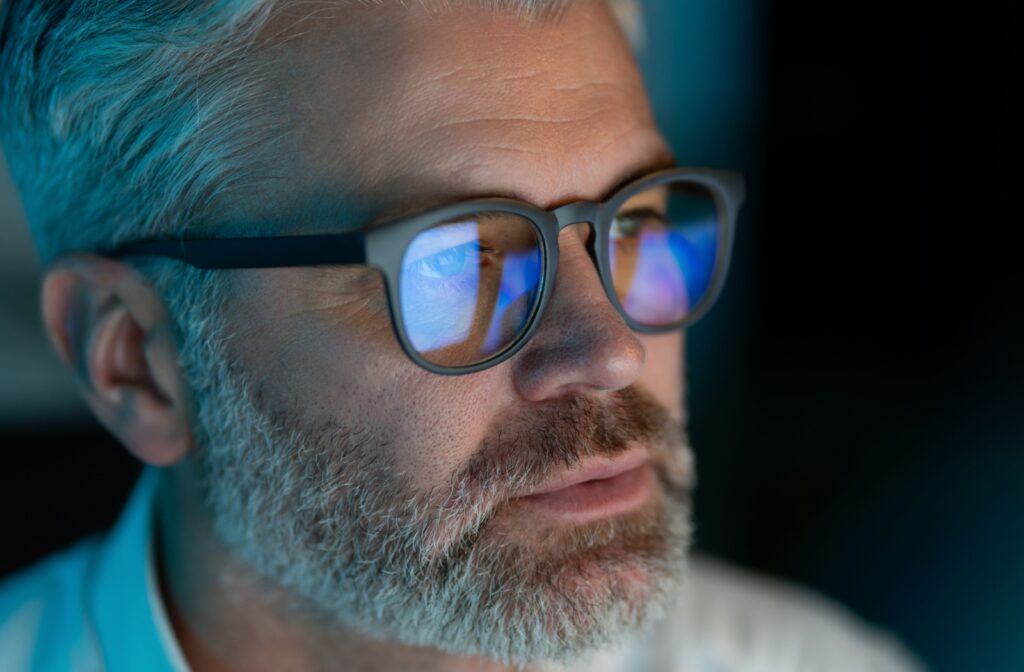
What About Computer Glasses?
If you spend hours at a computer, you may need lenses designed for screen use.
Computer glasses help you focus at your usual screen distance. They may also reduce the need to lean forward or tilt your head to see clearly.
Progressive lenses work well for many people. However, a separate computer lens may offer a wider viewing area for desk work.
For this reason, it helps to think about how you use your eyes each day. Your eye doctor can recommend lenses based on your routine.
Why an Eye Exam Matters
Blurry near vision often comes with age. Even so, you should not assume that presbyopia is the only cause.
An eye exam can check your prescription and overall eye health. It can also help find other causes of blurry vision, such as dry eyes or certain eye conditions.
In addition, your eye doctor can check how well your eyes focus at different distances. This helps you find lenses that suit your needs.
If your vision changes suddenly, or you notice eye pain, flashes of light, or a sudden increase in floaters, seek prompt medical care.
See Small Print Clearly Again
You do not have to keep stretching your arms to read a menu or turning up the light to see your phone.
Presbyopia is a normal part of aging. However, the right prescription can make reading and other close tasks easier.
If your current glasses no longer meet your needs, it may be time for an update. An eye exam can help you decide whether reading glasses, progressive lenses, or computer glasses are the right fit.
Schedule an eye exam at Optical Illusions to check your vision and explore lens options that fit your daily life.
Schedule your appointment at 1 of our 4 conveniently located offices in San Jose, San Mateo, San Ramon, and Juneau.