

Understanding the Connection Between Autism and Vision
Children with autism spectrum disorder (ASD) often experience the world differently, including how they process visual information. While much attention is focused on communication, behavior, and sensory processing, vision and eye health are equally important aspects of a child’s overall development.
Research has shown that certain eye and vision conditions occur more frequently in children with autism than in the general pediatric population. Two commonly observed concerns are strabismus, a condition involving eye misalignment, and light sensitivity, also known as photophobia. Both conditions can affect learning, social interactions, mobility, and daily comfort.
Because the signs of vision problems may overlap with behaviors commonly associated with autism, underlying eye conditions are sometimes overlooked. A child who avoids eye contact, struggles with reading tasks, or becomes distressed in bright environments may be experiencing a visual challenge that deserves further evaluation. Comprehensive eye examinations play a critical role in identifying these issues and ensuring that children receive appropriate care and support.
What Is Strabismus?
Strabismus occurs when the eyes are not properly aligned and do not point in the same direction simultaneously. One eye may focus straight ahead while the other turns inward, outward, upward, or downward. The misalignment may be constant or occur intermittently, especially when a child is tired or concentrating.
Normal vision depends on both eyes working together as a coordinated team. When the eyes are aligned, the brain combines information from each eye into a single image, allowing for clear vision and accurate depth perception. In children with strabismus, the brain receives two different images, making it more difficult to process visual information efficiently.
Studies have found that strabismus is more common among children with autism than among neurotypical children. Although the exact reason for this association remains unclear, the increased prevalence highlights the importance of routine eye care and careful visual assessment.
How Strabismus Can Affect a Child with Autism
The effects of strabismus extend beyond the appearance of the eyes. Misalignment can interfere with depth perception, making it difficult to judge distances accurately. Tasks such as catching a ball, climbing stairs, navigating playground equipment, or participating in sports may become more challenging.
Some children develop compensatory behaviors, such as tilting the head, squinting, or closing one eye. Others may avoid visually demanding activities altogether because they are uncomfortable or frustrating.
If left untreated, strabismus can lead to amblyopia, commonly known as lazy eye. This occurs when the brain begins to ignore visual input from the misaligned eye, resulting in reduced vision. Early detection is important because treatment is generally most effective during childhood, when the visual system is still developing.
Parents and caregivers may notice signs such as eye drifting, frequent squinting, poor coordination, head tilting, difficulty tracking moving objects, or a tendency to bump into things. However, many autistic children may not be able to describe visual discomfort, making observation especially important.
Understanding Light Sensitivity
Light sensitivity, or photophobia, is another visual concern that may affect children with autism. Bright sunlight, fluorescent lighting, LED lights, glare from windows, and reflective surfaces may feel overwhelming or uncomfortable.
Many autistic children experience sensory processing differences that can heighten sensitivity to visual stimuli. As a result, ordinary lighting conditions may appear excessively bright or distracting. A child may cover their eyes, squint, avoid brightly lit rooms, wear hats indoors, or become upset in certain visual environments.
These reactions should not be dismissed as behavioral issues. Light sensitivity can be a genuine source of discomfort and may interfere with learning, concentration, and participation in everyday activities.
When Light Sensitivity May Be More Than a Sensory Issue
Although sensory processing differences often contribute to light sensitivity, photophobia should not automatically be attributed to autism alone.
Several eye conditions can cause or worsen sensitivity to light, including uncorrected refractive errors, dry eye disease, corneal abnormalities, inflammation within the eye, retinal disorders, and migraine-related visual symptoms. In some cases, binocular vision problems such as strabismus may also contribute to visual discomfort.
A comprehensive eye examination can help determine whether light sensitivity is related primarily to sensory processing, an underlying eye condition, or a combination of both. Identifying the cause is essential for developing an effective management plan and improving a child’s comfort.

When Vision Problems Look Like Autism Symptoms
One of the reasons vision problems can go undetected in children with autism is that they sometimes resemble behaviors commonly associated with ASD.
For example, a child who avoids looking directly at people may be experiencing visual discomfort rather than social avoidance. A child who appears inattentive during reading activities may be struggling to keep the eyes aligned or focused. A child who becomes overwhelmed in brightly lit settings may be reacting to photophobia rather than the environment itself.
Similarly, poor depth perception caused by strabismus can make a child appear clumsy or uncoordinated. Without a thorough eye examination, these signs may be incorrectly attributed solely to autism.
Recognizing the possibility of an underlying visual issue is an important step toward ensuring that children receive the support they need.
Why Comprehensive Eye Examinations Matter
Vision screenings performed at school or during routine pediatric visits can identify some vision problems, but they are not designed to detect every condition that may affect visual function.
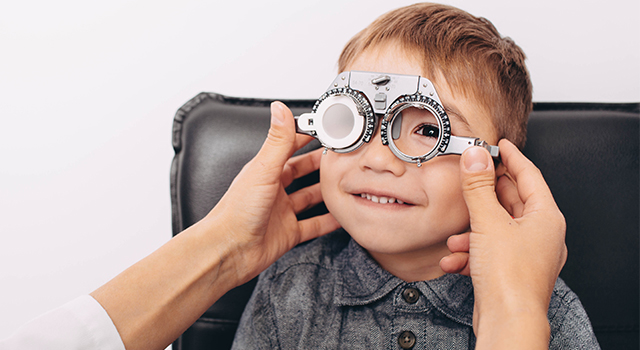
A comprehensive eye examination evaluates much more than a child’s ability to see letters on an eye chart. It includes assessments of visual acuity, refractive error, eye alignment, eye movements, focusing ability, depth perception, and overall eye health. The examination may also identify factors contributing to light sensitivity and visual discomfort.
For children with autism, these examinations can uncover visual challenges that may affect learning, communication, attention, mobility, and behavior. Early identification allows for timely intervention and can prevent some conditions from worsening over time.
Importantly, a child can pass a vision screening and still have significant visual difficulties. This is why regular comprehensive eye care is recommended, particularly when parents, teachers, or healthcare providers notice concerning visual behaviors.
Supporting Children Through the Examination Process
Many parents worry that their child may not be able to complete an eye examination because of communication challenges, anxiety, or sensory sensitivities. Fortunately, eye care professionals experienced in working with neurodiverse children often adapt the examination process to meet individual needs.
Appointments may be modified by reducing sensory distractions, providing additional time, using visual demonstrations, simplifying instructions, and offering breaks when necessary. Parents are often encouraged to participate in ways that help their child feel comfortable and secure.
Modern pediatric eye care also includes specialized techniques that allow vision to be assessed even when a child has limited verbal communication skills. Valuable information about visual function can often be obtained regardless of developmental differences.
Treatment and Management
When strabismus is identified, treatment options may include prescription glasses, treatment for amblyopia, vision therapy, or surgery, depending on the child’s specific diagnosis. Early treatment generally provides the best opportunity for healthy visual development.
Management of light sensitivity depends on the underlying cause. Treatment may involve correcting vision problems, addressing eye disease, reducing glare, modifying lighting conditions, or recommending specialized lenses when appropriate.
Many families report improvements in comfort, attention, participation, and overall quality of life after visual concerns are addressed. While treatment may not eliminate every challenge associated with autism, improving visual function can remove obstacles that make daily activities more difficult.
Conclusion
Strabismus and light sensitivity are important yet frequently overlooked concerns in children with autism. Because these conditions can influence learning, behavior, sensory regulation, and overall quality of life, they deserve careful attention from parents, educators, and healthcare providers.
Comprehensive eye examinations provide an opportunity to identify visual problems that might otherwise remain undetected. Early diagnosis and appropriate treatment can improve comfort, visual function, and a child’s ability to engage more successfully with the world around them.
Ensuring healthy vision is an essential part of supporting the growth, development, and well-being of every child with autism. By recognizing the signs of strabismus and light sensitivity and seeking timely evaluation, families can help ensure that visual challenges do not become barriers to learning, communication, and everyday success.
Schedule your appointment at 1 of our 4 conveniently located offices in San Jose, San Mateo, San Ramon, and Juneau.