


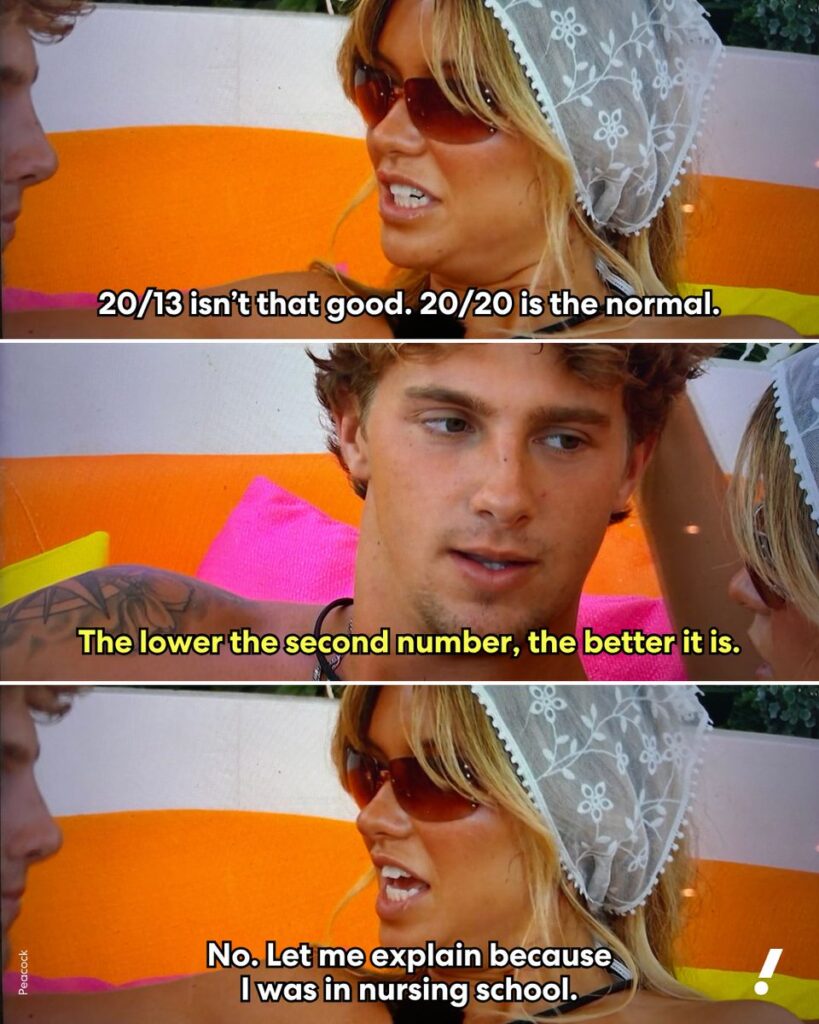
A recent moment on Love Island sparked an unexpected debate about eyesight. During a conversation, Caleb shared that he has 20/13 vision. Kenzie then responded that she has 20/30 vision and suggested that her eyesight was better.
The exchange quickly caught viewers’ attention. After all, many people do not know what those numbers mean. At first glance, 30 seems larger than 13, so it might sound like 20/30 should be better.
However, when it comes to vision scores, that is not how the system works.
In fact, based on the way eyesight is measured, Caleb’s 20/13 vision is sharper than Kenzie’s 20/30 vision.
To understand why, it helps to know how eye doctors measure vision and how the Snellen chart works.
What Happened on Love Island?
In the now-viral conversation, Caleb mentioned that he has 20/13 vision. Kenzie then said she has 20/30 vision and appeared to believe that her eyesight was stronger.
As a result, social media users quickly joined the discussion. Some viewers agreed with Caleb. Others sided with Kenzie. Meanwhile, many admitted they had no idea which number represented better vision.
The confusion is understandable.
Unlike test scores, sports statistics, or grades, vision measurements do not work on a “higher is better” system.
Instead, the opposite is often true.
Therefore, before deciding who was right, we need to understand what the numbers actually mean.
What Do Vision Numbers Mean?
During an eye exam, your eye doctor measures something called visual acuity.
Visual acuity simply describes how clearly you can see details at a distance.
The results are usually written as fractions, such as:
- 20/20
- 20/30
- 20/40
- 20/15
- 20/13
Although these numbers can seem confusing, they are actually fairly simple once you break them down.
The first number is the testing distance. In the United States, that number is usually 20 because the test is performed at 20 feet.
The second number tells us how far away a person with standard vision can stand and still read the same line.
For example:
- 20/20 means you see at 20 feet what a person with normal vision sees at 20 feet.
- 20/30 means you must stand 20 feet away to see what a person with normal vision could see from 30 feet away.
- 20/13 means you can see at 20 feet what a person with normal vision would need to move up to 13 feet away to see.
As a result, the lower the second number, the better the visual acuity.
Why Caleb’s 20/13 Vision Is Better
This is where the Love Island debate becomes easy to answer.
A person with 20/13 vision can see smaller details from farther away than someone with 20/20 vision.
Meanwhile, a person with 20/30 vision cannot see distant details quite as clearly as someone with 20/20 vision.
Let’s look at it another way.
Imagine there is a small sign across a field.
Caleb can read the sign from farther away because of his 20/13 vision.
Kenzie would need to move closer before she could read the same sign clearly.
Therefore, Caleb’s visual distance is sharper.
Based on the science behind visual acuity, Caleb’s statement about having 20/13 vision indicates better vision than 20/30.
Why the Numbers Feel Backward
Many people make the same mistake because the numbers seem backwards.
In everyday life, bigger numbers often mean better performance.
For example:
- Higher test scores are better.
- More points usually mean success.
- A larger number often sounds more impressive.
However, vision measurements are different.
With visual acuity, the bottom number represents how close a person must be to see a certain level of detail.
Therefore, a smaller number is actually better.
That is why:
- 20/13 is better than 20/20
- 20/20 is better than 20/25
- 20/25 is better than 20/30
The lower the second number, the sharper the vision.
How the Snellen Chart Works
The vision numbers used during eye exams come from the Snellen chart.
This is the familiar chart with large letters at the top and smaller letters near the bottom.
During the test, patients stand a specific distance away and read the letters line by line.
Each row is designed to represent a certain level of visual detail.
As the letters get smaller, the test becomes more challenging.
The smallest line you can read accurately helps determine your visual acuity score.
Therefore, someone who can read more lines near the bottom of the chart typically has better distance vision.
Who Created the Snellen Chart?
The Snellen chart was developed in 1862 by Dutch eye doctor Hermann Snellen.
Before his invention, there was no standard way to measure eyesight.
As a result, vision testing varied from one doctor to another.
The Snellen chart changed that by creating a consistent system that eye care professionals could use around the world.
More than 160 years later, it remains one of the most common ways to measure visual acuity.
Is 20/20 Perfect Vision?
Another common myth appeared during the online discussion.
Many people assume 20/20 vision is perfect vision.
Actually, 20/20 is considered standard or average visual acuity.
Some people naturally see better than that.
Examples include:
- 20/15
- 20/13
- 20/10
These measurements indicate above-average distance vision.
Therefore, Caleb’s 20/13 vision would be considered better than standard 20/20 vision.
On the other hand, 20/30 vision is slightly below standard visual acuity.
That does not mean someone has poor eyesight. It simply means they do not see distant details quite as clearly.
Does Better Vision Mean Healthier Eyes?
Not always.
This is another important point.
Visual acuity only measures how clearly you see.
Eye health is a separate issue.
For example, a person could have:
- 20/13 vision
- Excellent distance clarity
- An eye disease that has not yet affected vision
Likewise, someone with healthy eyes may still need glasses because of nearsightedness, farsightedness, or astigmatism.
Therefore, having sharp vision does not automatically mean your eyes are completely healthy.
Regular comprehensive eye exams remain important for everyone.
The Verdict on the Love Island Debate
The Love Island conversation created a fun discussion, but the answer is clear once you understand the numbers.
Caleb said he has 20/13 vision.
Kenzie said she has 20/30 vision and suggested that she could see better.
Based on how visual acuity is measured, Caleb’s 20/13 vision is sharper than Kenzie’s 20/30 vision.
The confusion comes from the fact that vision scores do not follow the same rules as grades or points. Instead, a smaller bottom number means you can see finer details at a distance.
So, while the debate may continue online, the Snellen chart gives us the answer:
20/13 vision is better than 20/30 vision.
The next time you hear someone compare eyesight numbers, remember this simple rule: when it comes to the second number, smaller is better.
Schedule your appointment at 1 of our 4 conveniently located offices in San Jose, San Mateo, San Ramon, and Juneau.