

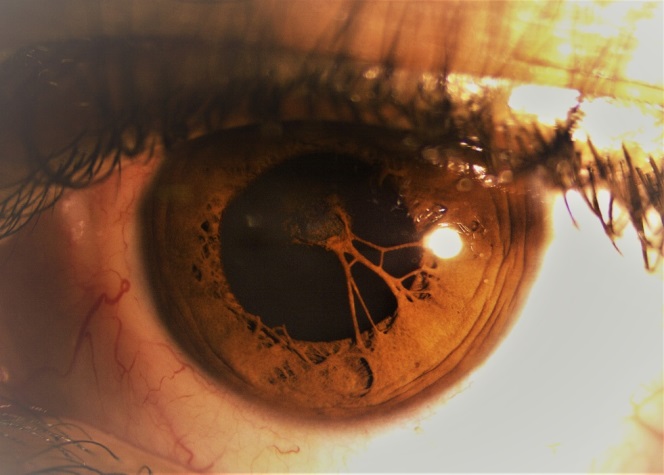
Before birth, a baby’s eyes grow fast. During this time, several temporary structures help the eyes develop. Most of these structures disappear before birth. Sometimes, though, small pieces remain. One example is a persistent pupillary membrane, or PPM.
A persistent pupillary membrane is a common eye finding. Most cases are harmless. In fact, many people never know they have one. Even so, it helps to understand what it is and why it happens.
What Is a Persistent Pupillary Membrane?
A persistent pupillary membrane is leftover tissue from fetal development.
Before birth, the lens needs nutrients to grow. To help, a network of blood vessels forms inside the eye. Small strands of tissue stretch across the pupil as part of this network.
Later, the eye becomes more mature. At that point, the tissue is no longer needed. The body then removes it.
Sometimes the process is not complete. As a result, a few strands remain after birth.
Doctors call these remaining strands a persistent pupillary membrane.
What Does It Do Before Birth?
The membrane has an important job before birth.
The growing lens cannot get nutrients on its own. Therefore, temporary blood vessels support it.
The pupillary membrane is part of this support system.
As the eye develops, the lens becomes less dependent on these vessels. The body then breaks the tissue down.
In most babies, the membrane disappears completely.
However, small remnants can remain.
Why Does It Stay?
Doctors do not always know why the tissue stays.
In most cases, it is simply a variation in development.
Importantly, it is present at birth.
It is not caused by an injury, an infection or by anything a parent did.
Instead, a small part of fetal tissue remains after the eye develops.
How Common Is It?
Persistent pupillary membrane is common.
Many newborns have tiny remnants of this tissue.
Over time, some strands disappear.
Others remain for life.
As a result, many adults have a mild PPM.
Most never know it is there.
Because symptoms are rare, doctors often find it during a routine eye exam.
What Does It Look Like?
The appearance can vary.
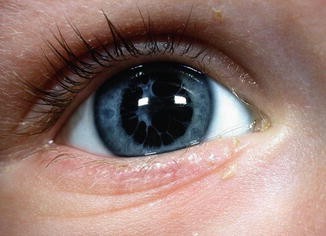
Some membranes look like fine threads.
Others look like a small web.
The strands often stretch from one part of the iris to another.
The iris is the colored part of the eye.
Most strands are very thin.
Because of that, they usually do not affect sight.
Does Persistent Pupillary Membrane Affect Vision?
Most people with a PPM have normal vision.
The strands are usually too small to block light.
As a result, vision remains clear.
Many patients never notice the condition.
Occasionally, a membrane is larger.
When this happens, part of the pupil may be covered.
Less light enters the eye.
Consequently, vision may become blurry.
Fortunately, this is uncommon.
Common Symptoms of Persistent Pupillary Membrane
Most people have no symptoms.
When symptoms occur, they may include:
- Mild blurry vision
- Reduced clarity
- Glare
- Light sensitivity
- A shadow in part of the vision
Even then, symptoms are usually mild.
For this reason, many people discover the condition during an eye exam.
Why Is It Important in Children?
Vision plays a key role in childhood development.
The brain learns how to process images during the early years.
Therefore, clear vision is important.
A dense membrane can sometimes block part of the pupil.
As a result, the eye may not send a clear image to the brain.
Over time, this can lead to amblyopia.
Amblyopia is also called lazy eye.
This condition can reduce vision if left untreated.
Because of this risk, eye doctors monitor children carefully.
How Is Persistent Pupillary Membrane Diagnosed?
Diagnosis is usually quick and simple.
An eye doctor uses a slit lamp microscope to examine the front of the eye.
This microscope provides a close view of the pupil and iris.
The strands are often easy to see.
The doctor may also test:
- Visual acuity
- Eye alignment
- Lens health
- Pupil function
- Overall eye health
These tests help determine whether the membrane affects vision.
Fortunately, the exam is painless.
Is It the Same as a Cataract?
No. A PPM is different from a cataract.
A cataract affects the lens.
The lens becomes cloudy.
As a result, vision becomes blurry.
A persistent pupillary membrane is not a cloudy lens.
Instead, it is leftover tissue near the pupil.
Although both conditions can affect sight, they are very different.
An eye exam can easily tell them apart.
Can It Be Linked to Other Eye Conditions?
Most PPMs occur by themselves.
However, some people may have other eye conditions as well.
Examples include:
- Congenital cataracts
- Microphthalmia
- Other developmental eye conditions
Because of this possibility, doctors examine the entire eye.
Fortunately, most patients have no related problems.
Does Persistent Pupillary Membrane Need Treatment?
Most cases do not need treatment.
If vision is normal, monitoring is usually enough.
Regular eye exams help ensure the condition stays stable.
Therefore, observation is the most common approach.
Can Glasses Help?
Glasses may improve vision in some cases.
Many people with a PPM also have common vision problems.
These include:
- Nearsightedness
- Farsightedness
- Astigmatism
Glasses cannot remove the membrane.
However, they can sharpen vision by correcting these refractive errors.
As a result, vision may become clearer.
Treatment for Children
Children with vision problems may need extra care.
The goal is to support healthy visual development.
Treatment may include:
- Prescription glasses
- Vision monitoring
- Eye patching
Early treatment is important.
In many cases, prompt care leads to better results.
Can Surgery Remove Persistent Pupillary Membrane?
Surgery is rarely needed.
Most membranes are too small to cause problems.
In rare cases, a dense membrane blocks the visual axis.
The visual axis is the path light takes into the eye.
If vision is affected, treatment may be recommended.
Options include:
- Laser treatment
- Microsurgical removal
Fortunately, only a small number of patients need these procedures.
Can It Go Away?
Some membranes continue to shrink during infancy.
As a child grows, the strands may become less noticeable.
Membranes that remain into adulthood usually stay there.
Even so, they rarely cause problems.
Because of this, treatment is often unnecessary.
Why Routine Eye Exams Matter
Routine eye exams can find conditions that have no symptoms.
A persistent pupillary membrane is one example.
Many people do not know they have it.
During an exam, an eye doctor can evaluate the membrane and check overall eye health.
In addition, regular exams help detect other eye conditions early.
Final Thoughts
A persistent pupillary membrane is a small remnant of fetal eye development. Before birth, this tissue helps nourish the growing lens. Normally, it disappears as the eye matures. Sometimes, small strands remain.
Fortunately, most cases are harmless. Vision is usually normal. Treatment is rarely needed. In many people, the condition is found only during a routine eye exam.
Although larger membranes can affect vision, serious problems are uncommon. Regular eye exams help ensure healthy vision and proper monitoring. For most patients, a persistent pupillary membrane is simply a small reminder of how the eye developed before birth.
Schedule your appointment at 1 of our 4 conveniently located offices in San Jose, San Mateo, San Ramon, and Juneau.