


Have you ever wondered whether one of your eyes is “in charge” when you look at something? Just as many people have a dominant hand, most people also have a dominant eye. Eye dominance, sometimes called ocular dominance, refers to the tendency for your brain to rely slightly more on visual information from one eye than the other. However, this does not necessarily mean that your dominant eye sees better. Both eyes work together as a team, and the brain combines information from each eye to create a single, three-dimensional view of the world.
So, what exactly is a dominant eye, how can you tell which eye is dominant, and does it actually matter for your vision?
What is Eye Dominance?
Your dominant eye is generally the eye that your brain tends to favor when processing visual information, particularly when you’re focusing on a specific target.
This is similar to having a dominant hand. You might use both hands throughout the day, but one hand may naturally take the lead when writing, throwing a ball, or performing a precise task.
Your eyes work in a similar way. Both eyes send visual information to the brain, but the brain may preferentially use information from one eye when determining where an object is located. Importantly, eye dominance is not the same thing as having better vision in one eye. For example, you could have 20/20 vision in both eyes and still have a dominant eye. Conversely, one eye could have a stronger prescription than the other without necessarily being your dominant eye.
Why Do We Have a Dominant Eye?
Your brain receives slightly different visual information from each eye because the eyes view the world from slightly different positions. Your brain combines these two images to create binocular vision—the ability to perceive the world as a single image and judge depth.
Eye dominance is thought to be related to how the brain prioritizes visual information from one eye during certain tasks. This doesn’t mean that your non-dominant eye is unimportant. Quite the opposite: both eyes contribute to normal vision.
Having two functioning eyes gives you a wider field of view and helps your brain judge distances and depth. Your eyes constantly work together, even though one may be favored for certain visual tasks.
How Can You Tell Which Eye Is Dominant?
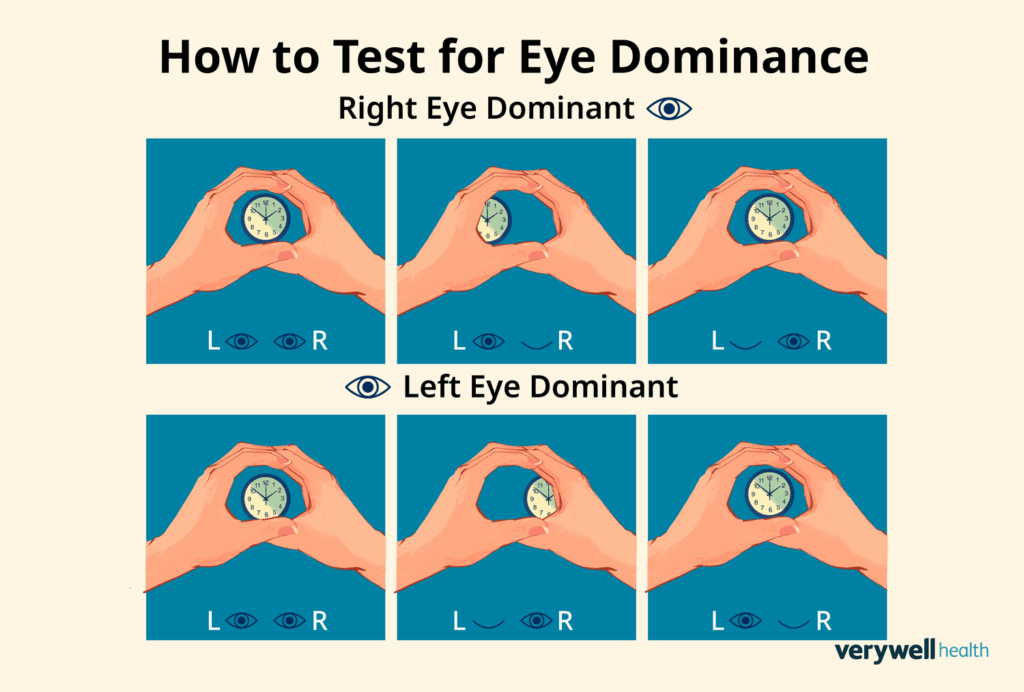
There are several simple ways to test eye dominance. One common method is sometimes called the Miles test.
Here’s how it works:
- Extend your arms in front of you and create a small opening between your hands or fingers.
- With both eyes open, look through the opening at a distant object, such as a light switch or picture on a wall.
- Keeping your hands in the same position, close one eye.
- Open that eye and close the other.
- Notice which eye keeps the object centered in the opening.
The eye that keeps the object in approximately the same position when the other eye is closed is generally considered your dominant eye.
Keep in mind that simple at-home tests aren’t a comprehensive assessment of your vision. Different methods can sometimes produce different results, particularly because eye dominance isn’t always absolute.
Can Your Dominant Eye Change?
For some people, eye dominance appears to be relatively consistent. For others, dominance may be less clear-cut and can vary depending on the task or testing method.
This is one reason it’s important not to think of eye dominance as a permanent “on/off” designation. Your brain is remarkably adaptable. Visual processing can change depending on what you’re doing, how you’re viewing a target, and the visual information available to each eye.
In other words, your eyes don’t necessarily have a strict hierarchy where one eye is always dominant and the other is always secondary.
Is Your Dominant Eye the Same as Your Dominant Hand?
Not necessarily.
You might be right-handed and right-eye dominant, but you could also be right-handed and left-eye dominant. When eye dominance and hand dominance are on opposite sides, this is sometimes called cross-dominance. For everyday activities, cross-dominance usually isn’t a problem. However, it can become more noticeable during activities that require precise coordination between vision and movement.
For example, athletes, photographers, and people participating in certain activities that require aligning their vision with a target may notice their eye dominance more than someone who doesn’t perform these tasks regularly.
Does Eye Dominance Affect Your Vision?
For most people, eye dominance isn’t something they need to think about on a daily basis.
Your brain is designed to use information from both eyes simultaneously. Even if one eye is dominant, your non-dominant eye still contributes important information to your overall visual experience. However, eye dominance can become relevant in certain situations involving binocular vision, where the two eyes need to work together effectively.
An eye doctor may consider the relationship between your eyes when evaluating things such as differences in prescription, focusing ability, depth perception, and how comfortably your eyes work together.
What If One Eye Has a Much Stronger Prescription?
It’s common for people to have slightly different prescriptions in each eye. But when the difference becomes significant, it can sometimes affect how the brain combines the images from each eye.
If the two eyes produce images that differ significantly in size or clarity, the brain may have difficulty combining them comfortably. Depending on the individual, this can contribute to symptoms such as eyestrain, headaches, or difficulty with depth perception.
Eye dominance can be one piece of the overall visual picture, but it isn’t the only factor an optometrist considers. A comprehensive eye examination can determine whether your two eyes are working together effectively and whether a difference in prescription needs attention.
Does Eye Dominance Matter for Contact Lenses?
Eye dominance can sometimes be relevant when fitting certain types of contact lenses.
One example is mono vision, a contact lens strategy sometimes used to help people with presbyopia see at different distances. In a mono vision approach, one eye may be corrected primarily for distance vision while the other is corrected more for near vision.
Because the brain needs to adapt to receiving different types of visual information from each eye, determining which eye is dominant can be useful when planning certain mono vision corrections.
However, contact lens prescriptions should never be selected based solely on an eye dominance test. Your optometrist considers your prescription, visual needs, eye health, lifestyle, and how well your eyes work together when determining the best correction.
Does Eye Dominance Affect Sports?
Eye dominance can be particularly interesting for athletes.
Activities that involve aiming, tracking, or coordinating hand movements with a visual target may make eye dominance more noticeable. This can include sports such as archery, shooting, baseball, golf, and other activities where precise visual alignment is important.
For example, someone whose dominant eye and dominant hand are on opposite sides may need to experiment with positioning to find what feels most natural. That doesn’t mean having cross-dominance puts someone at a disadvantage. Training, technique, experience, and many other factors influence athletic performance.
What About Depth Perception?
One of the biggest advantages of having two eyes is stereoscopic vision, which helps the brain perceive depth.
Because each eye sees the world from a slightly different angle, the brain can compare the two images and use those differences to estimate how far away objects are.
Your dominant eye doesn’t do this job alone. Depth perception depends on information from both eyes and how effectively the brain combines that information.
This is why maintaining good vision in both eyes is important, even if one eye is considered dominant.
Dominant Doesn’t Mean “Better”
Perhaps the most important thing to understand about eye dominance is that dominant doesn’t mean superior.
Your dominant eye isn’t necessarily stronger, healthier, or clearer than your non-dominant eye. Eye dominance describes how your brain tends to prioritize visual information; it doesn’t automatically tell us anything about the health or quality of vision in either eye.
That’s also why discovering that you have a dominant eye isn’t necessarily a reason for concern.
Your eyes are designed to work together, and your brain is exceptionally good at combining their input.
When Should You Have Your Eyes Checked?
If you’ve noticed a significant difference between your eyes, blurry vision, double vision, headaches while reading, difficulty focusing, or changes in depth perception, it’s worth discussing these symptoms with an optometrist.
A comprehensive eye exam can evaluate much more than whether you can read the letters on an eye chart. Your optometrist can assess your prescription, eye health, focusing ability, eye coordination, and how effectively your eyes work together.
Understanding which eye is dominant can be interesting, but the bigger picture is how well both eyes function as a team.
The Bottom Line
Most people have a dominant eye, but that doesn’t mean the other eye is less important. Your brain relies on information from both eyes to provide clear, comfortable, three-dimensional vision.
Eye dominance may be relevant in certain activities, vision correction strategies, and binocular vision assessments, but it is just one small part of the way your visual system works.
If you’re curious about your own eye dominance, or you’ve noticed that your two eyes don’t seem to work equally well, your optometrist can help determine what’s going on and make sure both eyes are working together as effectively as possible. Schedule your appointment at 1 of our 4 conveniently located offices in San Jose, San Mateo, San Ramon, and Juneau.