

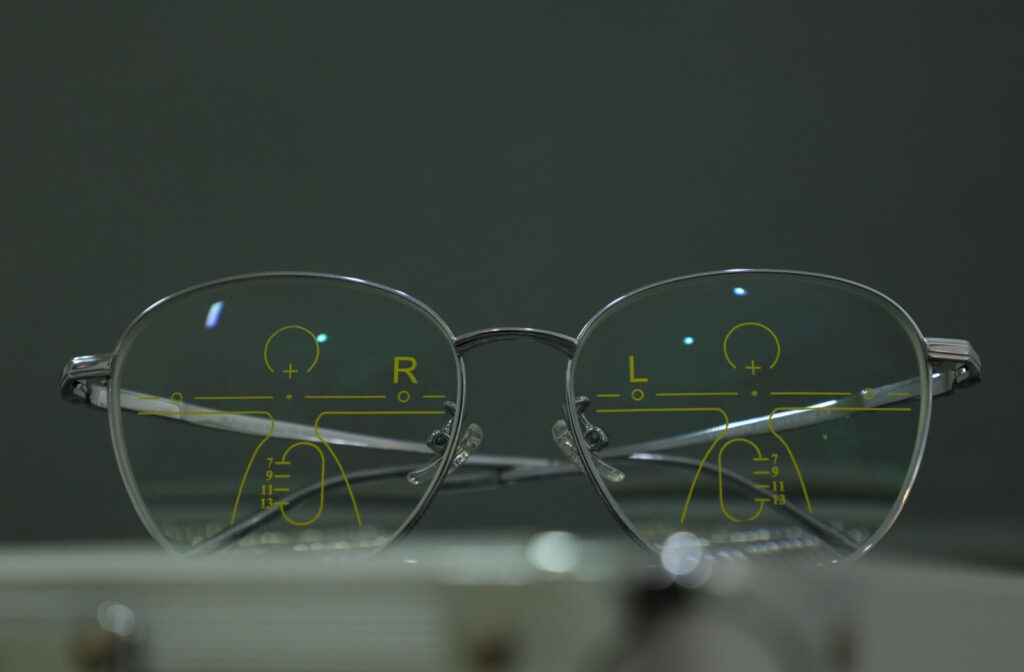
Getting new glasses is more than choosing a frame. Your prescription is only one piece of the puzzle. The lens design matters, too. So do the measurements.
Each type of lens is made for a different job. Some help you see far away. Others help you read. Some help you work on a computer. Meanwhile, others let you do all of these with one pair of glasses.
In addition, every lens must be customized to your eyes. Even a small measuring error can affect your vision. Therefore, accurate measurements are just as important as an accurate prescription.
Let’s explore how multifocal prescriptions work and why precise measurements make all the difference.
Why Do You Need Different Lens Designs?
Your eyes focus at different distances throughout the day.
For example, you may drive to work. Then, you look at a computer. Later, you read a text message. Finally, you relax with a book.
Each task uses a different viewing distance.
When you’re younger, your eyes adjust naturally. However, after age 40, that ability slowly decreases. This change is called presbyopia.
As a result, many people need help seeing up close. Fortunately, several lens options are available.
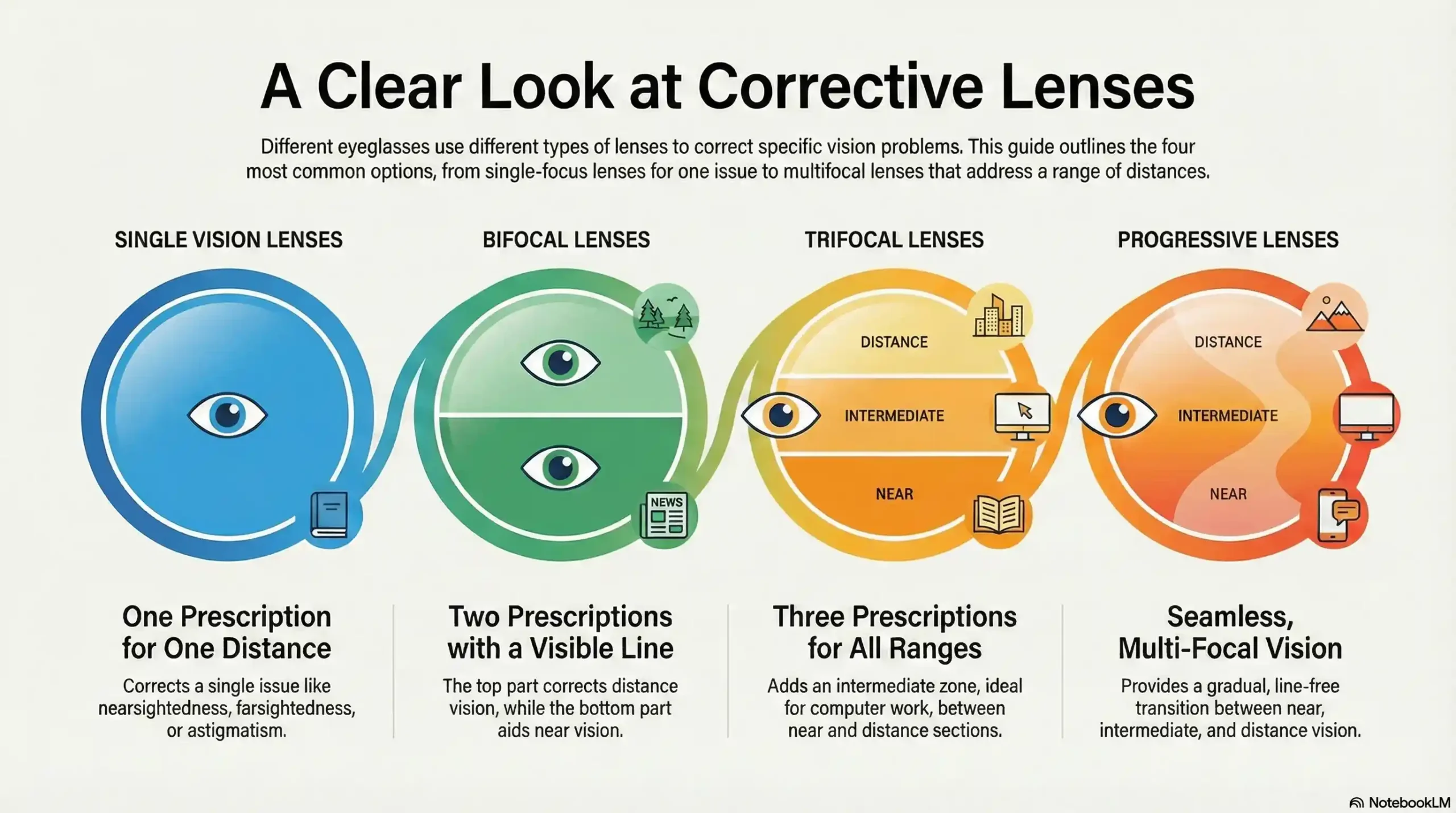
Distance Single Vision Prescription Lenses
Distance single vision lenses have one prescription across the entire lens.
They are designed for seeing far away.
These lenses work well for:
- Driving
- Watching TV
- Walking outdoors
- Sports
- Classroom presentations
However, they do not help with reading. Therefore, many people remove them when looking at their phone or a book.
Reading Single Vision Prescription Lenses
Reading glasses also have one prescription. However, they are made only for close work.
They help with:
- Reading books
- Looking at your phone
- Sewing
- Crossword puzzles
- Small print
These lenses make near objects clear. However, objects farther away become blurry.
Because of this, you will usually take them off when you finish reading.
Computer Single Vision Prescription Lenses
Computer lenses are made for intermediate vision.
Your computer screen usually sits farther away than a book. Therefore, reading glasses may feel too strong.
Computer lenses help you see clearly at about arm’s length.
They work well for:
- Office work
- Remote meetings
- Multiple monitors
- Gaming
- Graphic design
As a result, many people experience less eye strain. In addition, they often sit with better posture because they no longer lean toward the screen.
Progressive Prescription Lenses
Progressive lenses combine several prescriptions into one lens.
Unlike old-fashioned bifocals, they have no visible lines.
Instead, the prescription changes smoothly from top to bottom.
Each section serves a purpose.
The top helps you see far away.
The middle helps you see your computer, dashboard, or people across a desk.
Finally, the bottom helps you read books, menus, and your phone.
Because everything is built into one lens, you don’t need to switch glasses throughout the day.
Although there is a short adjustment period, most people adapt within a few days or weeks.
Near Variable Focus Prescription Lenses
Near Variable Focus (NVF) lenses are designed for people who spend most of their day indoors.
These lenses focus on near and intermediate vision.
Therefore, they are perfect for:
- Computer work
- Reading
- Crafting
- Music
- Cooking
- Office jobs
Unlike standard progressives, NVF lenses provide a wider reading and computer area.
As a result, many people enjoy a more comfortable workday.
However, these lenses are not made for driving because they do not prioritize distance vision.
Why Measurements Matter for Your Prescription
Your prescription tells the lab how strong the lenses should be.
Your measurements tell the lab where to place that prescription.
Both are equally important.
Imagine buying custom shoes. The size matters. However, the fit matters just as much.
The same is true for glasses.
Even the best lenses can feel wrong if the measurements are inaccurate.
Pupillary Distance (PD)
PD stands for Pupillary Distance.
This measurement tells us how far apart your pupils are.
The optical center of each lens must line up with your pupils.
If the PD is incorrect, you may notice:
- Blurry vision
- Eye strain
- Headaches
- Double vision
- Trouble focusing
Therefore, PD is one of the most important measurements for every pair of glasses.
Optical Center (OC)
The Optical Center, or OC, measures the vertical position of your eyes within the frame.
Everyone wears frames differently.
Some sit higher.
Others sit lower.
Because of this, the optical center must match where your eyes naturally sit.
If it does not, your eyes may constantly work harder to see clearly.
As a result, vision can feel uncomfortable, even if the prescription is correct.
Segment Height (Seg Height)
Segment height is especially important for progressive, bifocal, and trifocal lenses.
This measurement tells the lab exactly where the reading area begins.
If the segment height is too high, you may look through the reading portion while walking.
If it is too low, you may struggle to read because you cannot reach the near zone.
Therefore, even a difference of a few millimeters can change how the lenses perform.
Why Frame Choice Matters
Changing your frame can also change your measurements.
Even if your prescription stays the same, your new frame may sit differently on your face.
Therefore, measurements should be taken every time you purchase new glasses.
Using measurements from an old frame may reduce the performance of your new lenses.
The Bottom Line
A multifocal prescription is more than numbers on a piece of paper. It is a customized solution for the way you live.
Distance lenses help you see the road. Reading lenses make books and phones clear. Computer lenses reduce digital eye strain. Progressive lenses combine multiple viewing distances into one pair. Meanwhile, Near Variable Focus lenses give indoor workers a wider, more comfortable viewing area.
However, none of these lenses will perform as intended without accurate measurements.
Your PD, optical center, and segment height help place each prescription exactly where your eyes need it. As a result, you enjoy clearer vision, greater comfort, and a smoother visual experience.
When your prescription and your measurements work together, your glasses can truly perform at their best.
Schedule your appointment at 1 of our 4 conveniently located offices in San Jose, San Mateo, San Ramon, and Juneau.