


Your Child’s Vision Is Changing Every Day. The Question Is: Are You Acting Fast Enough?
Many parents assume that nearsightedness, also known as myopia, is simply a matter of getting stronger glasses every year. Unfortunately, that belief can have lifelong consequences.
Every year that myopia progresses, your child’s eyes become physically longer. While a stronger prescription may restore clear vision, it does nothing to stop the eye from continuing to grow. That excessive eye growth dramatically increases the risk of serious eye diseases later in life, including retinal detachment, glaucoma, cataracts, and myopic macular degeneration.
Here’s the reality that every parent should know: the earlier myopia management begins, the better the long-term outcome.
Waiting even one or two years can allow irreversible changes to occur inside your child’s eyes. Once the eye has elongated, it cannot naturally return to its original length.
Fortunately, today’s technology gives parents powerful tools to slow myopia progression before it becomes a lifelong problem. Three of the most effective options include:
- Stellest® spectacle lenses
- MiSight® 1 day contact lenses
- Orthokeratology (Ortho-K) lenses
Each treatment works differently, and each is ideal for different children and lifestyles. Understanding these options can help you make one of the most important decisions for your child’s future eye health.
Understanding Myopia: More Than Just Blurry Distance Vision
Myopia occurs when the eye grows too long from front to back. Light entering the eye focuses in front of the retina instead of directly on it, causing distant objects to appear blurry.
Traditional glasses or contact lenses simply move the focus onto the retina so your child can see clearly.
They do not stop the eye from continuing to grow.
This distinction is incredibly important.
Think of traditional glasses like replacing worn tires on a car without fixing the alignment problem. The immediate issue improves, but the underlying cause continues getting worse.
Modern myopia management aims to slow the actual growth of the eye itself.
Why Delaying Myopia Treatment Can Be a Costly Mistake
Parents often hear comments such as:
“They’re still young.”
“Let’s see if it gets worse.”
“They only need glasses.”
Unfortunately, myopia doesn’t usually wait.
Children’s eyes often change rapidly during elementary and middle school years. Some children progress by half a diopter or more every year.
That may not sound significant, but over several years it can mean the difference between moderate and high myopia.
Higher prescriptions aren’t just inconvenient.
High myopia substantially increases the lifetime risk of:
- Retinal tears and detachments
- Myopic macular degeneration
- Glaucoma
- Early cataracts
- Permanent vision loss
The goal isn’t simply helping children see better today.
The goal is protecting the health of their eyes for decades to come.
Why Starting Earlier Produces Better Results
Research consistently shows that earlier intervention provides greater long-term benefits.
Children typically experience the fastest eye growth between ages 6 and 12.
This is precisely when myopia management is most effective.
Every year treatment is delayed gives the eye additional time to elongate.
Although treatment can still help older children and teenagers, earlier treatment generally preserves more vision over a lifetime.
Parents often ask:
“What prescription should my child reach before starting?”
The better question is:
“Why wait for it to become worse?”
How Modern Myopia Management Works
Today’s treatments are designed to reduce the signals that encourage excessive eye growth.
Although each technology approaches this differently, they all share one common objective:
Slow the progression of myopia while providing excellent vision.
The three leading options each offer unique advantages depending on the child’s age, prescription, maturity level, sports participation, and family preferences.
Stellest Lenses: The Best Choice for Children Who Prefer Glasses
Stellest lenses are one of the newest and most advanced spectacle lens technologies designed specifically for myopia management.
Unlike ordinary glasses, Stellest lenses contain hundreds of highly aspherical lenslets surrounding the clear central viewing area.
These lenslets create what researchers call a volume of myopic defocus.
This optical design sends signals that help slow excessive eye growth while allowing children to enjoy sharp central vision.
Stellest lenses are excellent for:
- Younger children
- Children not ready for contact lenses
- Kids who prefer wearing glasses
- Families wanting simple daily wear
- Children new to myopia management
Parents appreciate that children simply wear them like normal glasses.
There are no special cleaning routines or insertion techniques.
Just put them on each morning.
Clinical studies have demonstrated impressive reductions in myopia progression when compared to standard single-vision lenses.
MiSight 1 Day Contact Lenses: Freedom Without Compromising Eye Health
Many children become interested in contact lenses as they become more active.
Sports, dance, gymnastics, and other activities often become easier without glasses.
MiSight 1 day contact lenses provide an excellent solution.
Unlike standard contact lenses, MiSight lenses are FDA-approved specifically for slowing the progression of myopia in children.
Their dual-focus optical design simultaneously provides clear vision while creating peripheral defocus that helps reduce eye elongation.
MiSight is ideal for:
- Responsible children
- Active athletes
- Kids involved in sports
- Children wanting freedom from glasses
- Families preferring daily disposable lenses
Daily disposable lenses also reduce many hygiene concerns because a fresh sterile lens is used every day.
There are no storage cases to clean and no reusable lenses to disinfect.
Many parents are surprised at how easily children adapt to wearing contact lenses.
Orthokeratology (Ortho-K): Clear Vision All Day Without Glasses
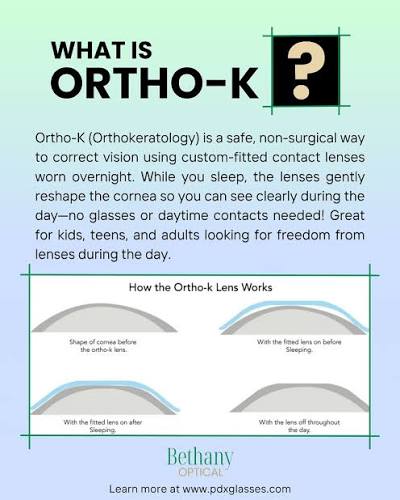
Orthokeratology, commonly called Ortho-K, offers a completely different approach.
Instead of wearing lenses during the day, specially designed rigid contact lenses are worn overnight while sleeping.
These lenses gently reshape the front surface of the cornea.
After removing them in the morning, children enjoy clear vision throughout the day without glasses or contact lenses.
For many families, this is an exciting option.
Children can:
- Swim without glasses
- Play sports freely
- Participate in outdoor activities
- Wake up seeing clearly every morning
Research has also shown that Ortho-K can effectively slow myopia progression by reducing axial eye growth.
Ortho-K is especially beneficial for:
- Competitive athletes
- Swimmers
- Soccer players
- Martial artists
- Children who dislike wearing glasses
- Kids motivated to follow nightly routines
Because success depends on consistent overnight wear and careful hygiene, motivation and parental support are essential.
Which Myopia Treatment Is Best?
There isn’t a single “best” treatment for every child.
Instead, the best option depends on the child’s unique needs.
Stellest Lenses
Best for:
- Younger children
- First-time treatment
- Kids comfortable wearing glasses
- Families seeking simplicity
MiSight Contact Lenses
Best for:
- Responsible children
- Sports participation
- Active lifestyles
- Children ready for contact lenses
Ortho-K
Best for:
- Highly active children
- Competitive athletes
- Children wanting daytime freedom
- Families committed to nightly lens care
Your optometrist will evaluate multiple factors, including:
- Age
- Prescription
- Rate of progression
- Eye health
- Lifestyle
- Sports participation
- Family goals
- Eye measurements, including axial length when appropriate
A personalized recommendation almost always provides the best long-term results.
Lifestyle Habits That Support Myopia Management
While treatment options are highly effective, healthy habits can further support your child’s eye health.
Encourage:
- At least two hours of outdoor time each day
- Frequent breaks during screen use
- Proper reading distance
- Good lighting while studying
- Limiting prolonged near work without breaks
These habits won’t replace myopia management, but they can complement professional treatment.
Common Myths About Myopia Management
Myth: My child will outgrow myopia.
False.
Children generally do not outgrow myopia. Instead, it often progresses throughout childhood before stabilizing in early adulthood.
Myth: Stronger glasses solve the problem.
False.
Stronger glasses improve vision but do not slow eye growth.
Myth: My child is too young.
Actually, younger children often benefit the most because treatment begins before significant eye elongation occurs.
Myth: We’ll wait until next year.
Unfortunately, every year of progression may permanently increase future risk.
Once eye growth occurs, it cannot simply be reversed.
The Cost of Waiting
Parents naturally want to make informed decisions.
However, delaying treatment while “watching and waiting” often means allowing preventable progression.
Imagine looking back years from now knowing treatment could have reduced your child’s prescription significantly.
Many parents who begin myopia management wish they had started sooner.
The encouraging news is that if your child has recently become nearsighted, today may still be the perfect time to act.
Regular Eye Exams Make All the Difference
Children don’t always recognize when their vision is changing. They may simply move closer to the board at school, hold books nearer to their face, or struggle during sports without realizing why.
Comprehensive eye exams are the key to detecting myopia early, monitoring progression, and determining whether your child is a candidate for advanced myopia management. During these visits, your optometrist can measure changes in prescription, evaluate overall eye health, and recommend the treatment option that best fits your child’s needs and lifestyle.
The sooner myopia is identified, the more opportunities there are to slow its progression and reduce the risk of serious eye disease later in life. Rather than waiting until your child needs stronger glasses, scheduling regular eye exams allows you to take a proactive approach to protecting their lifelong vision.
Protect Your Child’s Vision Before It’s Too Late
Myopia management isn’t simply about reducing the need for thicker glasses.
It’s about protecting your child’s eyesight for the future.
Whether your child is best suited for Stellest lenses, MiSight daily contact lenses, or Orthokeratology, early intervention offers the greatest opportunity to slow progression and preserve long-term eye health.
Every year matters. Every prescription change matters. Every eye exam matters.
The best time to begin myopia management is often when myopia is first diagnosed, not after it has significantly progressed.
Protect Your Vision and Enhance Your Look with Optical Illusions
Your child’s eyesight deserves more than stronger glasses each year. Early myopia management can help slow the progression of nearsightedness and reduce the risk of serious eye conditions later in life. At Optical Illusions: An Optometric Practice, our Board-Certified Optometrists specialize in creating personalized myopia management plans using advanced treatment options such as Stellest® lenses, MiSight® 1 day contact lenses, and Orthokeratology (Ortho-K). We provide expert fittings, high-quality lenses, and comprehensive eye exams to determine which solution best fits your child’s age, lifestyle, and vision needs.
Our comprehensive eye examinations include screenings for ocular risk, advanced diagnostic technology, precise measurements, and individualized care plans designed to help protect your child’s vision today and for years to come. Don’t wait for your child’s prescription to continue worsening. Schedule your appointment at 1 of our 4 conveniently located offices in San Jose, San Mateo, San Ramon, and Juneau locations and take the first step toward preserving a lifetime of healthy vision.