

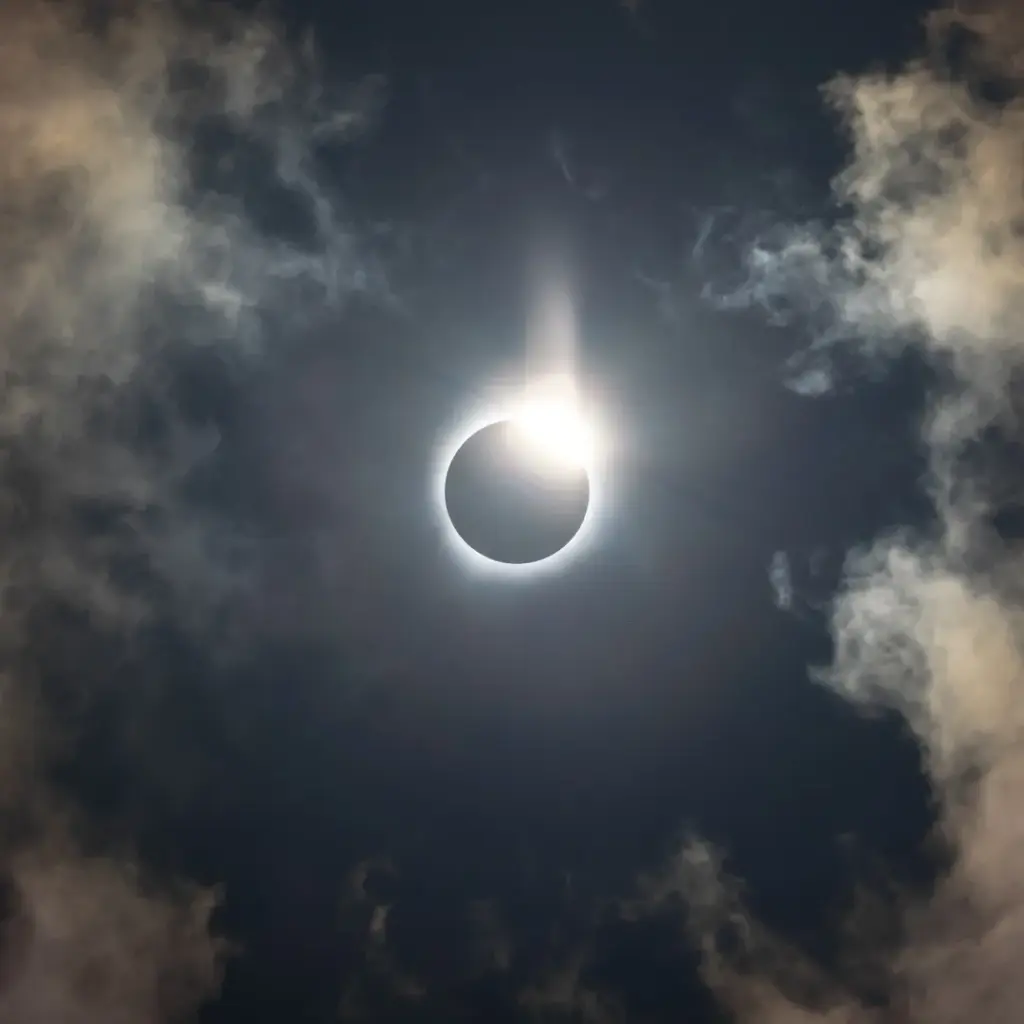
A solar eclipse is one of nature’s most amazing events. The Moon moves between the Earth and the Sun. As a result, the Moon blocks some or all of the Sun from view.
During an eclipse, the sky can become much darker. The temperature may even drop. Birds and animals may also react to the sudden change in light.
Still, one thing does not change.
The Sun remains powerful.
Looking directly at the Sun can damage your eyes. This is true even during a solar eclipse. In fact, the darker sky can make it easier to forget how bright the Sun still is.
So, what happens when sunlight enters your eye? Why can a small amount of visible Sun still cause damage? And how does a solar eclipse create those crescent-shaped images on the ground?
Understanding how light works can help explain why eye protection matters.
What Is a Solar Eclipse?
A solar eclipse happens when the Moon moves between Earth and the Sun.
Normally, sunlight travels directly toward Earth. During a solar eclipse, the Moon blocks part of that sunlight.
There are three main types of solar eclipses.
A total eclipse occurs when the Moon completely covers the bright surface of the Sun. This happens only along a narrow path on Earth.
A partial eclipse occurs when the Moon covers only part of the Sun.
An annular eclipse happens when the Moon passes in front of the Sun but does not completely cover it. A bright ring of sunlight remains around the Moon.
Each type looks different.
However, they all involve the same basic process. The Moon blocks some sunlight from reaching certain areas of Earth.
How Does a Solar Eclipse Change Sunlight?
During a solar eclipse, the Moon blocks a large amount of visible sunlight.
This makes the sky appear darker.
That change can be misleading.
The Sun may look less bright because most of its surface is covered. However, even a small visible portion of the Sun can produce extremely intense light.
Your eyes are designed to handle normal levels of light. They are not designed to stare directly at the Sun.
The remaining sunlight can still enter the eye. The eye then focuses that light onto the retina.
This is where the real danger begins.
How Does Light Enter the Eye?
Your eye works much like a camera.
Light first reaches the cornea. The cornea is the clear outer surface of the eye.
Next, light travels through the pupil.
The pupil is the opening in the center of the iris. It controls how much light enters the eye.
After passing through the pupil, light reaches the lens.
The lens helps focus the light.
Finally, the focused light reaches the retina at the back of the eye.
The retina contains millions of light-sensitive cells. These cells detect light and help create the images you see.
The information then travels through the optic nerve to the brain.
This system works extremely well under normal conditions.
Direct solar viewing is different.
How Can Solar Light Pass Through a Small Opening?
A small opening can still allow light to pass through.
You can see this effect during an eclipse.
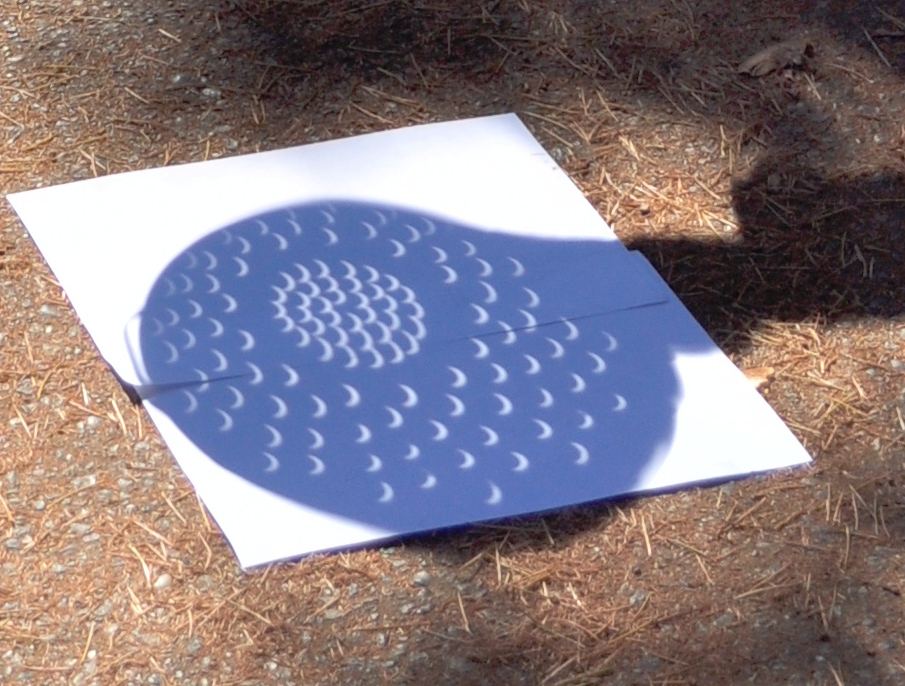
When sunlight passes through a small opening between tree leaves, it can create small images of the Sun on the ground.
These images may look like tiny crescents during a partial eclipse.
Why does this happen?
The openings between the leaves act like tiny pinhole cameras.
Light from the Sun travels through each opening. The light then forms an image on the surface below.
The smaller opening does not stop the light.
Instead, it changes how the light travels.
This is called the pinhole effect.
What Does the Pinhole Effect Have to Do With Your Eyes?
Your pupil is also an opening.
Light passes through the pupil before reaching the lens. The lens then focuses that light onto the retina.
This is important when thinking about solar eye safety.
The eye does not simply let sunlight spread across the retina.
Instead, the cornea and lens focus incoming light.
That focused light lands on a small area of retinal tissue.
This is similar to how a magnifying glass can concentrate sunlight into a small spot.
The eye’s optical system is much more complex than a magnifying glass. However, the basic idea is similar.
Light can be concentrated.
That concentration is one reason direct sunlight can be harmful.
Why Can Solar Light Damage the Retina?
The retina is delicate.
It contains specialized cells called photo receptors. These cells allow us to detect light.
There are two main types of photo receptors: rods and cones.
Rods help with low-light vision. Cones help us see color and fine detail.
The center of the retina contains the macula.
The macula is responsible for much of our central vision. It helps us read, recognize faces, and see small details.
At the center of the macula is the fovea.
The fovea provides our sharpest vision.
When you look directly at the Sun, the eye naturally focuses the image toward the central retina.
As a result, intense sunlight can affect the area responsible for detailed vision.
What Happens During Solar Retinopathy?
Direct solar viewing can cause an injury called solar retinopathy.
Solar retinopathy occurs when intense sunlight damages retinal tissue.
The damage can involve the photo receptor cells and other structures within the retina.
There are several factors involved in this injury.
Strong visible light can cause photo chemical damage. The Sun also produces ultraviolet and infrared radiation.
The eye’s natural structures provide some protection from ultraviolet light. However, direct solar viewing can still expose the retina to harmful levels of energy.
The retina can become injured even though you may not feel pain.
This is an important point.
The retina does not have the same pain-sensing system as many other parts of the body.
You can therefore damage your retina without feeling it happen.
Why Doesn’t Looking at the Sun Hurt Right Away?
Your eyes can become uncomfortable when exposed to bright light.
You may squint.
Your pupils may become smaller.
You may also look away because the light feels unpleasant.
These reactions provide some natural protection.
However, they do not make direct solar viewing safe.
The retina itself cannot produce the same pain signal that you might feel from a scratched cornea.
Because of this, someone can look at the Sun and feel fine at the time.
Symptoms can appear later.
That delay can make solar eye damage especially difficult to recognize.
What Are the Symptoms of Solar Retinopathy?
Symptoms can develop several hours after exposure.
In some cases, they may take longer to become noticeable.
Possible symptoms include:
- Blurry central vision
- A dark or blurry spot
- Distorted vision
- Reduced detail in the center of vision
- Changes in color perception
- Increased sensitivity to light
- Difficulty reading
- Difficulty recognizing faces
- A small blind spot
Symptoms may affect one eye or both eyes.
The severity can also vary.
Some people recover much of their vision over time. Others may have permanent changes.
There is currently no simple treatment that immediately reverses solar retinopathy.
That is why prevention remains the best approach.
Can Solar Retinopathy Heal?
Recovery depends on the severity of the retinal injury.
Some people experience improvement over weeks or months.
Others may continue to notice a blind spot or distortion.
In some cases, the damage can be permanent.
An eye doctor can evaluate the retina after a suspected injury. Special imaging, such as optical coherence tomography, may help show changes within the retinal layers.
If you notice unusual vision after viewing an eclipse, schedule an eye examination.
Do not wait for pain.
Retinal injuries may not cause pain at all.
Why Regular Sunglasses Are Not Enough
Regular sunglasses are helpful for everyday outdoor activities.
They reduce visible light and may provide ultraviolet protection when properly labeled.
However, regular sunglasses are not designed for looking directly at the Sun.
They do not reduce solar radiation enough for direct viewing.
This includes very dark sunglasses.
Dark lenses can make the Sun look more comfortable to view. However, they do not automatically make direct solar viewing safe.
The same applies to homemade filters.
Do not use:
- Regular sunglasses
- Multiple pairs of sunglasses
- Tinted plastic
- Smoked glass
- Film negatives
- CDs or DVDs
- Homemade filters
- Unverified solar filters
These methods can provide a false sense of safety.
How to Safely Watch a Solar Eclipse
The safest way to directly view a solar eclipse is with proper solar viewing equipment.
Use eclipse glasses or a handheld solar viewer that meets the appropriate safety standard.
Follow the manufacturer’s instructions.
Before using eclipse glasses, inspect them carefully.
Do not use them if they are scratched, torn, punctured, or damaged.
Also, avoid looking through binoculars, telescopes, or cameras while wearing ordinary eclipse glasses.
Optical equipment can magnify and concentrate sunlight.
Specialized solar filters designed for that equipment are required.
If you are unsure whether a product is safe, do not use it for direct solar viewing.
You Can Watch a Solar Eclipse Without Looking at the Sun
Direct viewing is not the only way to experience an eclipse.
A pinhole projector is a simple alternative.
It uses a small opening to project an image of the Sun onto another surface.
You can watch the projected image without looking directly at the Sun.
This is also a great way to understand how light travels.
The same pinhole effect explains the crescent-shaped images that appear beneath trees during a partial eclipse.
You can also watch an eclipse through a trusted live broadcast.
This provides another completely indirect way to experience the event.
Why Children Need Extra Reminders
Children may be especially curious during an eclipse.
The unusual sky can make them want to look up.
They may also assume that a darker Sun is less dangerous.
Adults should explain that the Sun remains bright even when the Moon covers most of it.
Make sure children understand how to use solar viewing glasses correctly.
Supervision can also help prevent accidental direct viewing.
The Importance of Solar Eye Safety
A solar eclipse is a rare and memorable event.
It gives us a chance to see the relationship between the Sun, Moon, and Earth.
It also provides a fascinating example of how light travels.
Small openings can create images. The eye can focus light. The retina can turn that light into vision.
However, the same optical system that helps us see can also expose the retina to intense sunlight.
That is why solar eye safety should always come first.
The Sun does not become safe simply because an eclipse makes the sky darker.
Even a small visible portion of the Sun can deliver enough energy to damage retinal tissue.
The Bottom Line
Solar eclipses are beautiful events, but they require careful eye protection.
The Moon may block most of the Sun. However, the remaining sunlight can still be extremely intense.
Your cornea and lens focus incoming light onto the retina. When you look directly at the Sun, that concentrated light can damage sensitive retinal cells.
This damage can cause solar retinopathy.
The injury may not hurt when it occurs. Symptoms can also take hours to appear.
For that reason, never look directly at the Sun without proper solar viewing protection.
Regular sunglasses are not enough.
Instead, use certified solar viewing glasses or an appropriate solar viewer. You can also use indirect viewing methods, such as a pinhole projector.
With the right precautions, you can enjoy a solar eclipse while protecting the vision that lets you see it.
Schedule your appointment at 1 of our 4 conveniently located offices in San Jose, San Mateo, San Ramon, and Juneau.