


Astigmatism is very common. However, many people do not understand it. In fact, some think it is a disease. Meanwhile, others think it is serious. In reality, it is usually simple to treat.
For example, you may see blurry words. In addition, lights may look stretched. You may also feel tired eyes. If so, astigmatism may be the cause.
Fortunately, doctors can test for it quickly. Then they can treat it easily. In most cases, glasses or contacts help a lot. Therefore, vision improves fast.
This guide explains astigmatism in simple terms. First, it covers what it is. Next, it explains what causes it. Finally, it shows how it is treated.
What Is Astigmatism?
Astigmatism is a problem with how the eye is shaped. To be specific, it affects the cornea, which is the front of the eye.
Normally, the cornea is round like a basketball. However, with astigmatism, it is shaped more like a football. Because of this shape difference, light does not focus correctly.
Instead of forming one clear point, light spreads out. As a result, vision becomes blurry or distorted.
For example, a bowtie shape can help explain it. In a normal eye, light focuses into one dot. In contrast, in astigmatism, the light stretches into a bowtie shape.
Therefore, vision is not sharp. In addition, astigmatism can affect both near and far vision. It may also affect one eye or both eyes.
What Does Astigmatism Look Like?
Astigmatism can look different for each person. For instance, some people see blur. Meanwhile, others see shadows or stretching.
Common signs include:
- Blurry vision
- Fuzzy words
- Shadowed images
- Wavy lines
- Stretched lights
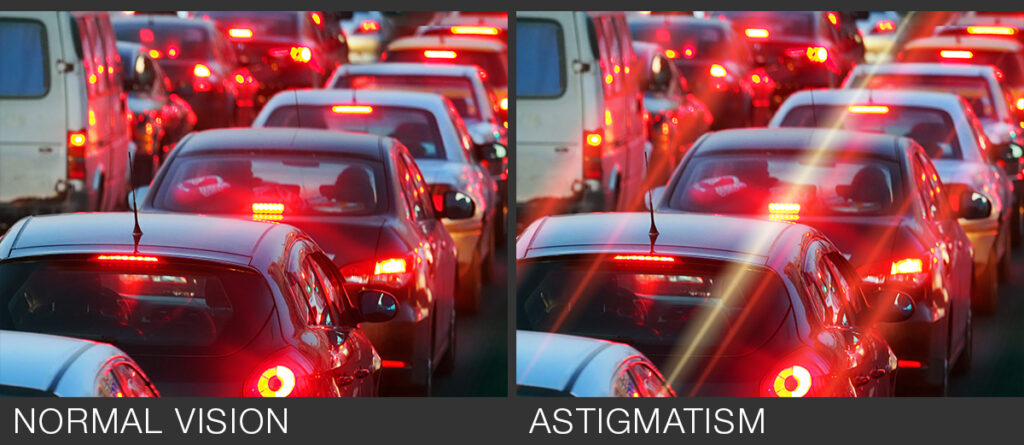
At night, lights may look streaky. In addition, halos may appear around them. Similarly, straight lines may look bent or tilted.
Mild astigmatism may not bother you much. However, stronger astigmatism usually causes more blur.
Common Symptoms
Astigmatism can affect daily life. For example, it may make reading harder. In addition, screen use may feel tiring.
Common symptoms include:
- Eye strain
- Squinting
- Headaches
- Tired eyes
- Trouble driving at night
- Light glare
- Trouble focusing
Therefore, daily tasks may feel more difficult. Moreover, children may not notice the problem. Instead, they may think their vision is normal. As a result, eye exams are very important.
What Causes Astigmatism?
Most people are born with it. In fact, it often runs in families. However, doctors do not always know the exact cause.
Still, genetics likely play a role. In addition, astigmatism can develop later in life. For example, it may happen after:
- Eye injury
- Eye surgery
- Corneal scars
- Keratoconus
Keratoconus is a condition where the cornea becomes thin. As a result, it bulges outward. Therefore, vision can become very distorted.
Is Astigmatism Normal?
Yes. In fact, it is very common. For example, many people have a small amount. As a result, they may not even notice it.
However, others need glasses or contacts. Importantly, astigmatism does not mean the eye is unhealthy. Instead, it only means light does not focus evenly.
In addition, many people also have nearsightedness or farsightedness.
Types of Astigmatism
There are two main types. First, there is corneal astigmatism. This happens in the cornea and is the most common type.
Second, there is lenticular astigmatism. This happens in the lens inside the eye.
In both cases, light does not focus correctly. As a result, vision becomes blurry.
Can Astigmatism Change?
Yes. Over time, it can change. For example, some people notice slow changes. Meanwhile, others notice faster changes.
This may happen because of aging. In addition, it may happen due to eye disease, injury, or surgery.
Furthermore, children may also experience changes as they grow. Therefore, regular eye exams are important.
How Is Astigmatism Diagnosed?
Eye doctors can find astigmatism during a routine exam. Fortunately, the tests are simple and painless.
First, there is the vision test. You read letters on a chart. This checks how clearly you see.
Next, there is the refraction test. The doctor places lenses in front of your eyes. Then, you compare which ones look clearer. As a result, the correct prescription is found.
In addition, doctors may check the cornea shape. For example, they may use keratometry or corneal mapping. Therefore, they can see detailed eye structure.
How Is Astigmatism Treated?
The good news is that treatment is usually simple. In most cases, vision improves quickly.
First, glasses are commonly used. They help focus light correctly. As a result, vision becomes clearer. However, new glasses may feel strange at first. Even so, most people adjust quickly.
Second, contact lenses may be used. These are called toric lenses. However, they must stay in the correct position. Otherwise, vision may become blurry. In some cases, rigid lenses are recommended for sharper vision.
Third, some people choose surgery. For example, LASIK reshapes the cornea. As a result, light focuses better. In addition, PRK and SMILE are other options. However, not everyone qualifies. Therefore, doctors check eye health first.
Can Astigmatism Cause Headaches?
Yes. When the eyes work harder, strain can build up. As a result, headaches may develop.
For example, this may happen after reading. In addition, it may happen after screen time or driving. Fortunately, proper correction often helps.
Is It Worse at Night?
Often, yes. At night, lights may look stretched. In addition, halos may appear around headlights.
This happens because pupils get larger in the dark. As a result, more light enters the eye. Therefore, blur can increase, especially while driving.
Can Children Have It?
Yes. Children can have astigmatism early. However, they may not notice it. Instead, they may assume their vision is normal.
For example, they may squint or sit close to screens. In addition, they may rub their eyes or avoid reading. Therefore, regular eye exams are very important.
Astigmatism vs Nearsightedness
These are different conditions. For example, nearsightedness affects distance vision. In contrast, astigmatism causes distortion at all distances.
However, both can happen together. As a result, vision may become even more blurry.
Can You Prevent It?
Usually, no. Most cases are genetic. However, you can still protect your eyes.
For example, wear safety glasses when needed. In addition, follow contact lens rules. Moreover, get regular eye exams. Therefore, you help protect long-term vision.
Does It Mean Bad Vision?
No. In fact, many people see well with correction. For example, glasses or contacts often fix the problem.
Meanwhile, some people only have mild astigmatism. As a result, they may not need treatment at all.
When Should You See a Doctor?
You should get an eye exam if you notice symptoms. For example:
- Blurry vision
- Headaches
- Eye strain
- Night driving trouble
- Squinting
- Reading problems
In addition, children should have regular eye checks. Therefore, vision problems can be caught early.
Final Thoughts
Astigmatism is very common. In fact, it happens when the eye is not evenly shaped. As a result, light does not focus properly.
Instead of one sharp point, light spreads out. Therefore, vision becomes blurry or distorted.
For example, it may look like a football or bowtie shape. However, the condition is very treatable.
In conclusion, glasses, contacts, and surgery can help a lot. If vision seems unclear, an eye exam is the best next step.Schedule your appointment at 1 of our 4 conveniently located offices in San Jose, San Mateo, San Ramon, and Juneau.